Psychologist, London. I study how minds work, and I build with the new ones. Move across my name.
I’m a psychologist. I took a First in Psychology at Goldsmiths and an MSc in Clinical Mental Health Sciences at UCL. Before that came business school in France and a sales floor in Madrid.
I think general-purpose AI arrives this decade,It’s a forecast, and I’ll update it when the evidence moves. and that it’ll change mental health and ordinary work more than anything else I’ll live through. So I’ve rebuilt how I work around it. A small staff of AI agents writes nearly all my code. My job is to point them somewhere worth going, and to check what they bring back.
The questions I care about sit where those two worlds meet. What happens to people who talk to machines all day? And how does a human stay a useful check on a system that’s smarter than them?
Now Looking for research roles where mental health meets AI: human-AI interaction, model behaviour, digital mental health. London, or remote from London.
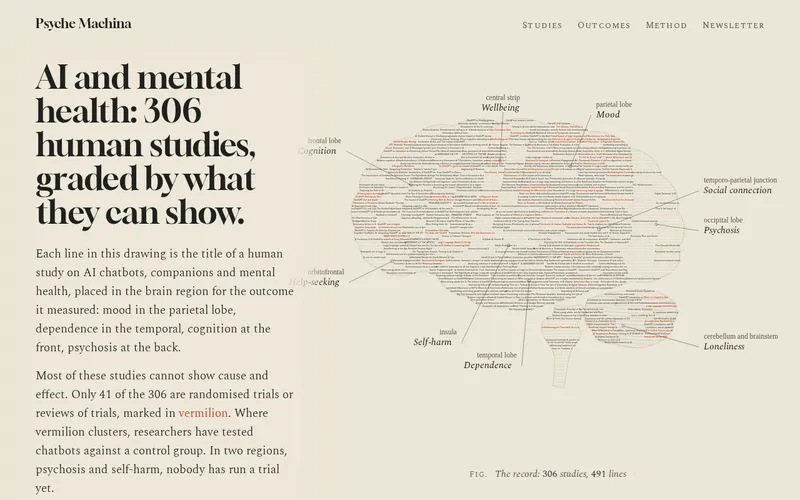
A living map of human studies on how AI use affects mental health, graded by what each study can show. It holds 306 studies so far. Only 41 are randomised trials, and in two areas, psychosis and self-harm, nobody has run a trial yet.
Fig. 1 Each line is the title of a study, placed in the brain region for the outcome it measured. Trials are in vermilion.
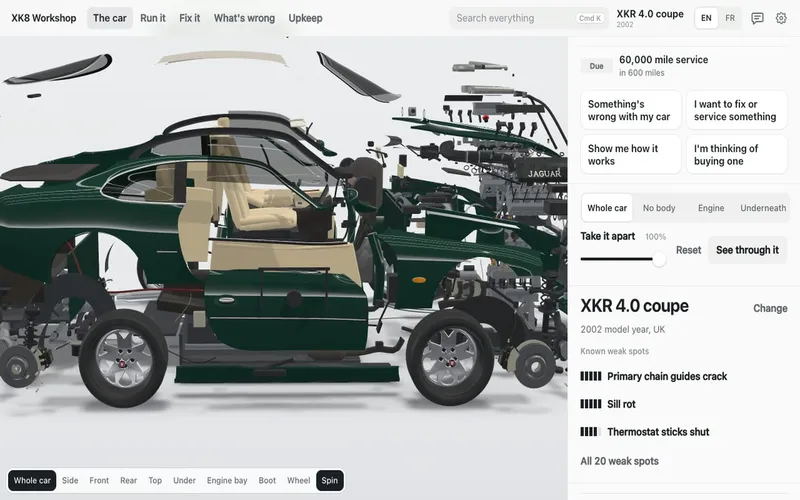
An interactive 3D workshop manual for the Jaguar XK8.Built for a phone propped on the wing, with greasy hands. Take the car apart, watch the engine run and follow 43 repair jobs with factory torques, in English or French. Every value shows its source, and missing values stay blank rather than guessed.
Fig. 2 The car taken apart, with the next service and the model’s known weak spots.
IrisHomelab · private
My homelab and personal operating system: 28 services on Proxmox, from photo backup to the assistants that run my week. About 4,900 commits since April, nearly all written by agents.Agents are optimistic narrators. The table exists because of that. Nothing counts as working until it clears the last row of this table:
Level
What was checked
What it proves
Source
Tests pass in the repository
The code hangs together
Deploy
The change reached the machine
It’s installed
Live
A fresh end-to-end run on the real system
It works
I packaged the rule for anyone as Homelab Operator, a small CLI that makes every pull request say what it proved and what it didn’t.
When AI helps you check AI, do you catch more errors or just feel surer? A reproducible study design with model-written summaries, seeded mistakes and 4 kinds of assistance, from a bare answer to a full verification checklist. The participants are simulated for now, so it’s a test of the design.